 ClawDeploy
Self-Hosting vs Managed AI Bot Hosting
You can self-host an AI bot. You can also change your own oil, bake your own bread, and hand-roll your SSL certificates while you are at it. The question is whether that is the best use of your Saturday.
The decision to self-host AI bot infrastructure or use a managed platform comes down to one thing: what you actually value more, total control or total velocity. OpenClaw is the open-source AI assistant framework that gives your bots persistent memory, custom skills, browser control, and proactive behaviour. ClawDeploy is the managed hosting platform that takes an OpenClaw bot from code to production in under a minute. No servers, no Docker, no 3am pager alerts.
Both paths work. But they cost very different things. Let's break down what each one actually involves so you can make the right call for your situation.
What It Takes to Self-Host an AI Bot
The first thing people underestimate about self-hosting is the checklist. It is not "spin up a VPS and run the bot." It is a full operational pipeline that you are now personally responsible for.
Here is what you actually need:
- A VPS or cloud VM. DigitalOcean, Hetzner, AWS EC2, whatever you prefer. You need to pick a region, pick a size, and hope you picked right because resizing later means downtime.
- Docker. Your bot needs a containerised runtime environment. That means writing a Dockerfile, managing images, handling build caching, and debugging "it works on my machine" when it inevitably does not work on the server.
- Node.js runtime. OpenClaw runs on Node. You need the right version, you need to keep it updated, and you need to deal with the occasional breaking change when you upgrade.
- Webhook configuration. Telegram and Discord both require a publicly accessible HTTPS endpoint. You need to register the webhook URL, handle verification, and make sure it stays pointed at the right place when your IP changes.
- SSL certificates. Webhooks require HTTPS. That means Let's Encrypt, Certbot, renewal cron jobs, and the quiet panic when your cert expires at 2am on a Sunday and your bot goes silent.
- DNS management. Point a domain (or subdomain) at your server. Update the records when you migrate. Remember that DNS propagation takes time when you are trying to fix something urgently.
- A process manager. pm2 or systemd to keep your bot running after crashes, reboots, and out-of-memory kills. You need to configure restart policies, set memory limits, and test that it actually recovers gracefully.
- Monitoring. How do you know your bot is down? If the answer is "a user tells me," you need monitoring. That means UptimeRobot, Grafana, Prometheus, or at minimum a health check endpoint and something that pings it.
- Log management. Logs fill up disks. You need rotation, retention policies, and ideally a way to search them when something goes wrong.
journalctlworks until your server has been running for six months and you are grepping through 40GB of output. - Security patches. Your OS needs updates. Your dependencies need updates. Your Docker base image needs updates. Each one is a potential breaking change, and skipping them is a potential vulnerability.
- Scaling. Your bot gets popular. Congratulations. Now it is running out of memory and dropping messages. You need to vertically scale the VM, or horizontally scale with a load balancer, or accept that your bot stutters during peak hours.
That is not a weekend project. That is a part-time job. Every item on that list is one more thing that can break, and when it breaks, it is your problem. Your users do not care that your SSL cert expired or that Docker ran out of disk space. They care that the bot stopped responding.
The hidden cost of self-hosting is not the VPS bill. It is the cognitive overhead of being on call for infrastructure you did not want to manage in the first place.
The Managed Hosting Path with ClawDeploy
Now let's map every item from that self-hosting checklist to what happens with ClawDeploy.
- VPS or cloud VM? ClawDeploy provisions your bot's infrastructure automatically. Pick a region and you are done.
- Docker? Abstracted. You never see a Dockerfile, never debug a build, never run
docker compose upand pray. - Node.js runtime? Managed and updated by the platform. No version conflicts, no manual upgrades.
- Webhook configuration? Configured on deploy. Your Telegram or Discord bot gets its webhook registered automatically. One step, zero manual work.
- SSL certificates? Handled. Always valid, always renewed, always there.
- DNS? Your bot gets a stable endpoint. No records to manage, no propagation to wait for.
- Process manager? Built in. Your bot auto-restarts on crash. No pm2 config, no systemd unit files.
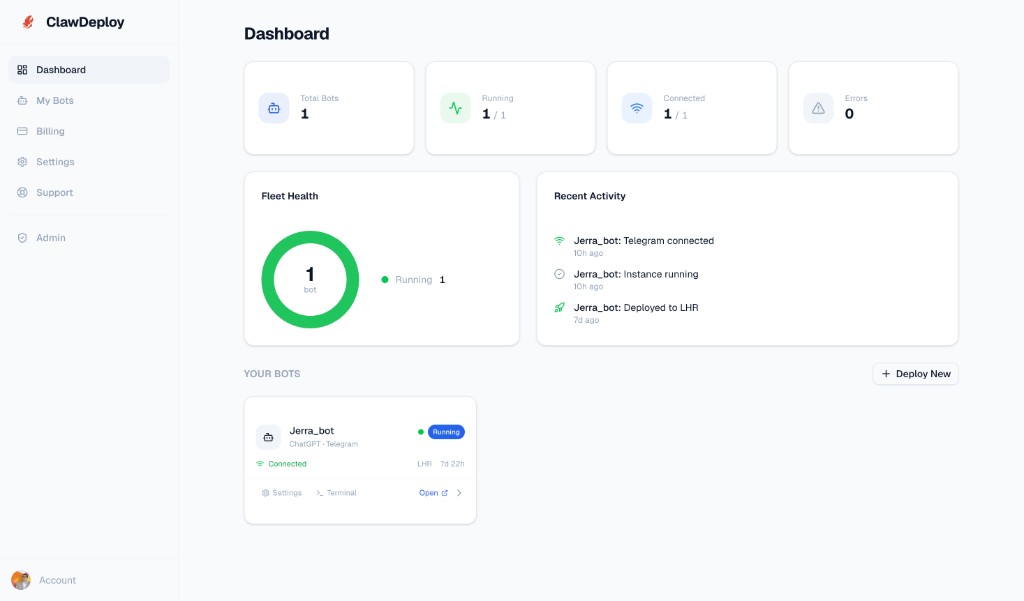
- Monitoring? Built in. Fleet health dashboard, uptime tracking, connection status at a glance.
- Log management? Built in. Searchable, accessible from the dashboard, without filling up anyone's disk.
- Security patches? The platform handles OS and runtime updates. You focus on your bot's logic, not its plumbing.
- Scaling? Upgrade your tier from the dashboard. No migration, no load balancer, no downtime.
The pattern is obvious. Every line item that costs you time, attention, and weekend hours in the self-hosting path is something ClawDeploy handles before you finish your coffee.
Source: clawdeploy.net/dashboard
If you want to see the full workflow, read the step-by-step guide to deploying a Telegram bot. It takes about sixty seconds from start to a live bot accepting messages.
Cost Comparison: Time, Money, and Sanity
Let's talk numbers. Not hypothetical "enterprise TCO" numbers. Real numbers for someone running one to five bots.
Self-hosting costs:
- VPS: $5 to $20/mo depending on specs and provider
- Your time: 2 to 4 hours initial setup, plus ongoing maintenance (updates, debugging, monitoring)
- SSL certificate management: free with Let's Encrypt, but your time configuring and troubleshooting renewals is not free
- Monitoring tools: free tier exists, but setting them up takes time
- The 3am wake-up when your bot crashes and a user DMs you about it: priceless (in the worst way)
ClawDeploy costs:
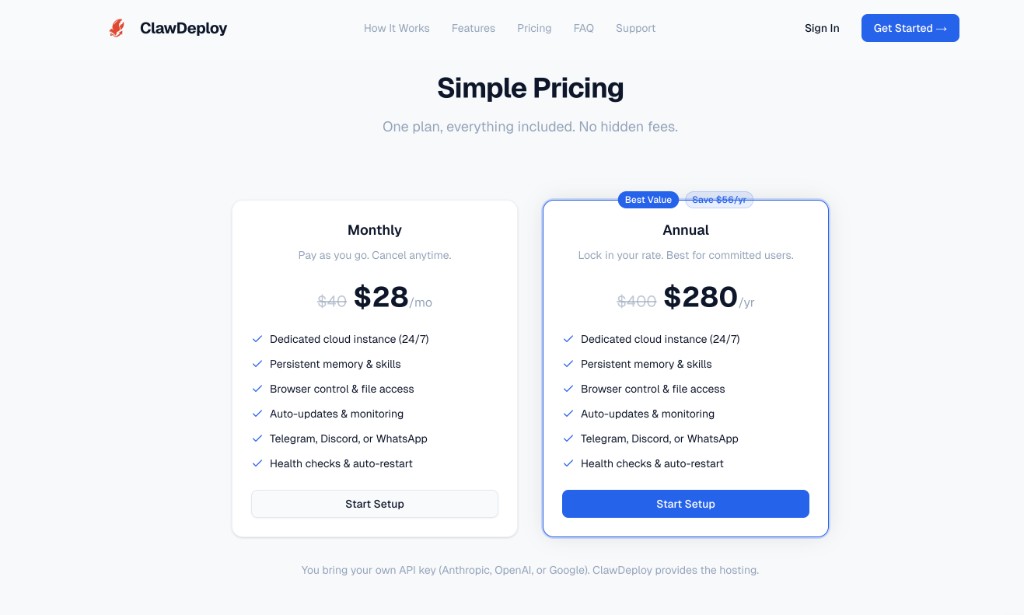
- Monthly plan: $28/mo
- Annual plan: $280/yr (saves you about two months)
- Everything included: hosting, monitoring, auto-restart, SSL, health checks, log access, fleet dashboard
- DevOps hours required: zero
The honest comparison: If you value your time at anything above minimum wage, the self-hosting path costs more than $28/mo the moment you spend two hours on initial setup. Every maintenance hour after that widens the gap. The VPS might be cheaper on paper, but paper does not account for the Saturday you spent debugging a Docker networking issue instead of building features for your bot.
That said, self-hosting gets more competitive at scale. If you are running 10+ bots and you have a dedicated DevOps person (or you are the DevOps person and you genuinely enjoy this), the per-unit cost of self-hosting drops significantly. At that point, the infrastructure overhead is amortised across many bots and you are operating closer to a platform yourself.
For everyone else, the math is simple. Your time is worth more than $28/mo.
Source: clawdeploy.net/pricing
Check the full pricing breakdown to see what is included at each tier.
When Self-Hosting Your AI Bot Makes Sense
This is the part where a lesser blog post would pretend self-hosting is never the right choice. We are not going to do that, because it would be dishonest and you would see right through it.
Self-hosting makes sense when:
- You are running a custom fork of OpenClaw. If you have modified the core framework extensively (added proprietary skills, changed the memory layer, integrated with internal systems), deploying your fork requires infrastructure you control. OpenClaw is fully open-source, and forking it for specialised use cases is exactly what open-source is for.
- You have strict compliance or data residency requirements. Some industries and regions require that data stays on infrastructure you own or in specific geographic jurisdictions. If your compliance team says "no third-party hosting," that is the end of the conversation.
- You operate in air-gapped environments. Government, defence, or high-security contexts where internet-connected managed platforms are not an option. Your bot needs to run on hardware that never touches the public internet.
- You are optimising cost at serious scale. Running 10, 20, or 50 bots with a dedicated DevOps team that already manages your infrastructure? Self-hosting is genuinely cheaper per bot at that volume. The operational overhead exists regardless, so spreading it across more bots makes the unit economics work.
These are legitimate reasons. If one applies to you, self-host with confidence. The OpenClaw documentation covers everything you need to get your own deployment running.
When Managed Hosting Wins
For everyone who does not fall into the categories above, managed hosting is not just convenient. It is the rational choice.
Solo founders who are building a product and need a bot running alongside it. You do not have time to manage infrastructure. You barely have time to eat lunch. Every hour you spend on DevOps is an hour you are not spending on the thing that actually makes money.
Small teams where nobody's job title includes "infrastructure." Your backend developer can configure a VPS, sure. But should they? Their time is better spent shipping features. The opportunity cost of DevOps is invisible on a spreadsheet but very real in your velocity.
Agencies deploying bots for clients. If you manage five clients who each want a Telegram bot, self-hosting means five separate infrastructure setups to maintain. With ClawDeploy, you deploy five bots in five minutes and move on to billable work. Read about seven ways to automate business workflows with AI assistants for ideas on what to build for your clients.
Anyone who values shipping over configuring. The math is relentless: if your time is worth more than $28/mo in DevOps hours (and it is), managed hosting wins every time. That is not a sales pitch. That is arithmetic.
Source: clawdeploy.net/dashboard/bots
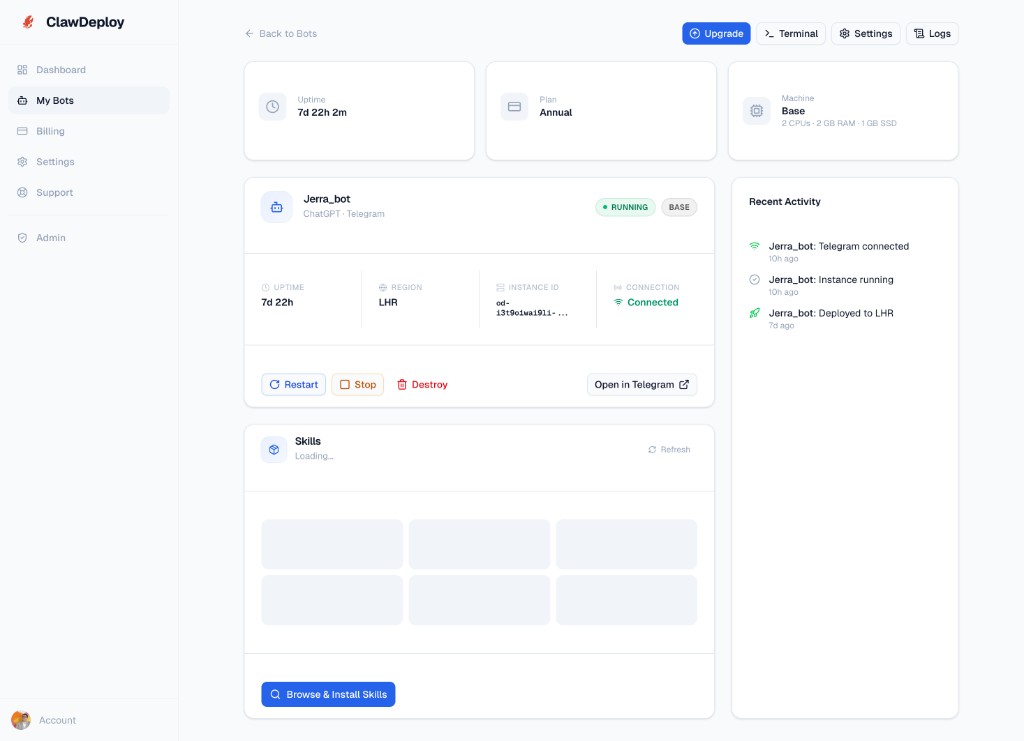
The dashboard gives you everything you need at a glance: uptime, region, connection status, installed skills, and recent activity. No SSH required. No log files to tail. Just a clean interface that tells you your bot is running and your users are happy.
The Hybrid Approach: Develop Locally, Deploy Managed
Here is the approach that gives you the best of both worlds: use OpenClaw locally for development and testing, then push to ClawDeploy for production.
During development, you get full control. Run the bot on your machine, test new skills, experiment with different models, tweak the persona, and iterate as fast as you can type. You have access to the full source code, you can set breakpoints, and you can watch every request flow through the system. This is where self-hosting shines: rapid, local, zero-latency iteration.
When your bot is ready for real users, deploy it to ClawDeploy. Your production environment gets auto-restart, monitoring, SSL, health checks, and scaling without you lifting a finger. You do not sacrifice development speed, and you do not take on operational burden. Development stays fast. Production stays stable.
This is not a compromise. It is the workflow that most professional software teams already use for their applications. You develop locally, you test locally, and you deploy to a managed platform. Nobody hand-rolls a production Kubernetes cluster to run their web app when Vercel exists. The same logic applies to AI bots.
Source: Telegram conversation with an OpenClaw assistant deployed via ClawDeploy
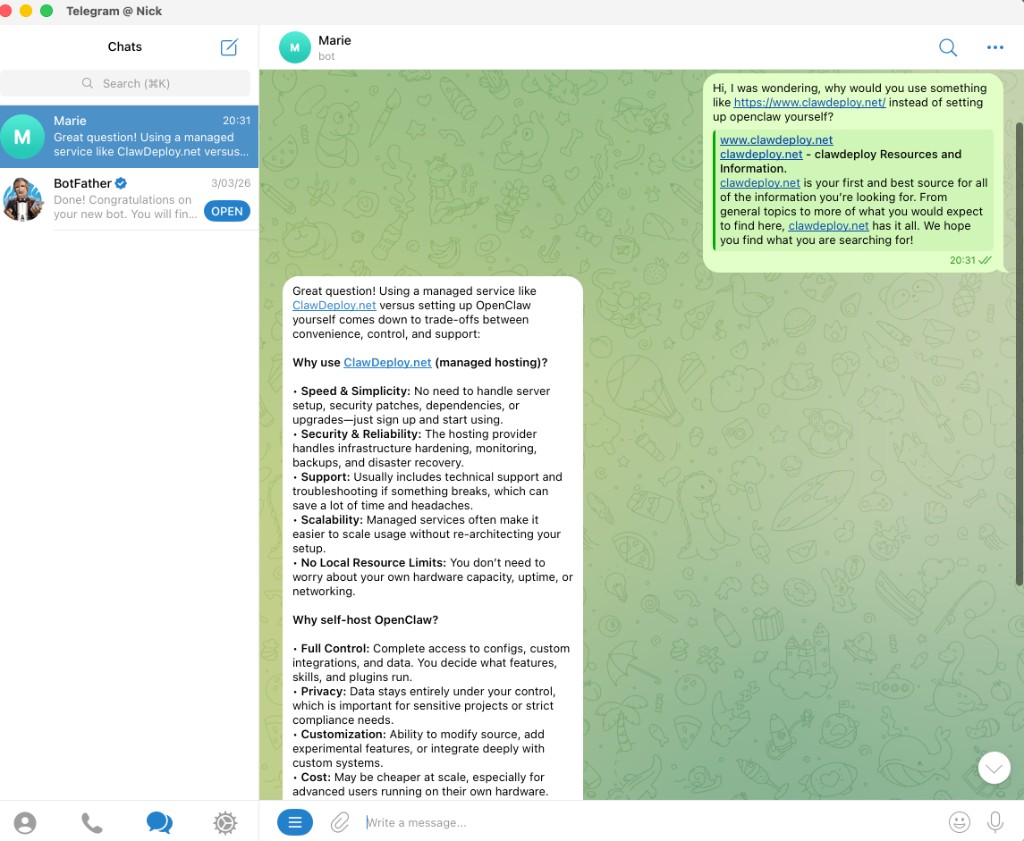
The conversation above is from a real OpenClaw bot running on ClawDeploy. It was developed locally, tested locally, and deployed in under a minute. That is the hybrid workflow in action.
For more inspiration on what to build, check out seven automation use cases that teams are running on ClawDeploy today.
Stop Debugging Docker and Start Deploying Bots
The best deployment is the one you do not have to think about after it is running. It does not wake you up at 3am. It does not require you to remember when SSL certs expire. It does not fall over when traffic spikes and leave you scrambling to SSH into a server.
Self-hosting is a valid choice for specific situations: custom forks, compliance requirements, air-gapped environments, and cost optimisation at serious scale. If that is you, OpenClaw gives you everything you need to run your own infrastructure.
For everyone else, the question is simple. Do you want to spend your time managing servers, or do you want to spend it building bots that do useful things for your users? ClawDeploy exists so you can do the second one.
Stop debugging Docker. Get started in under a minute.
Deploy Your AI Assistant
Pick a model, choose a channel, deploy. Go from zero to a running AI assistant on Telegram, Discord, or WhatsApp in under a minute.